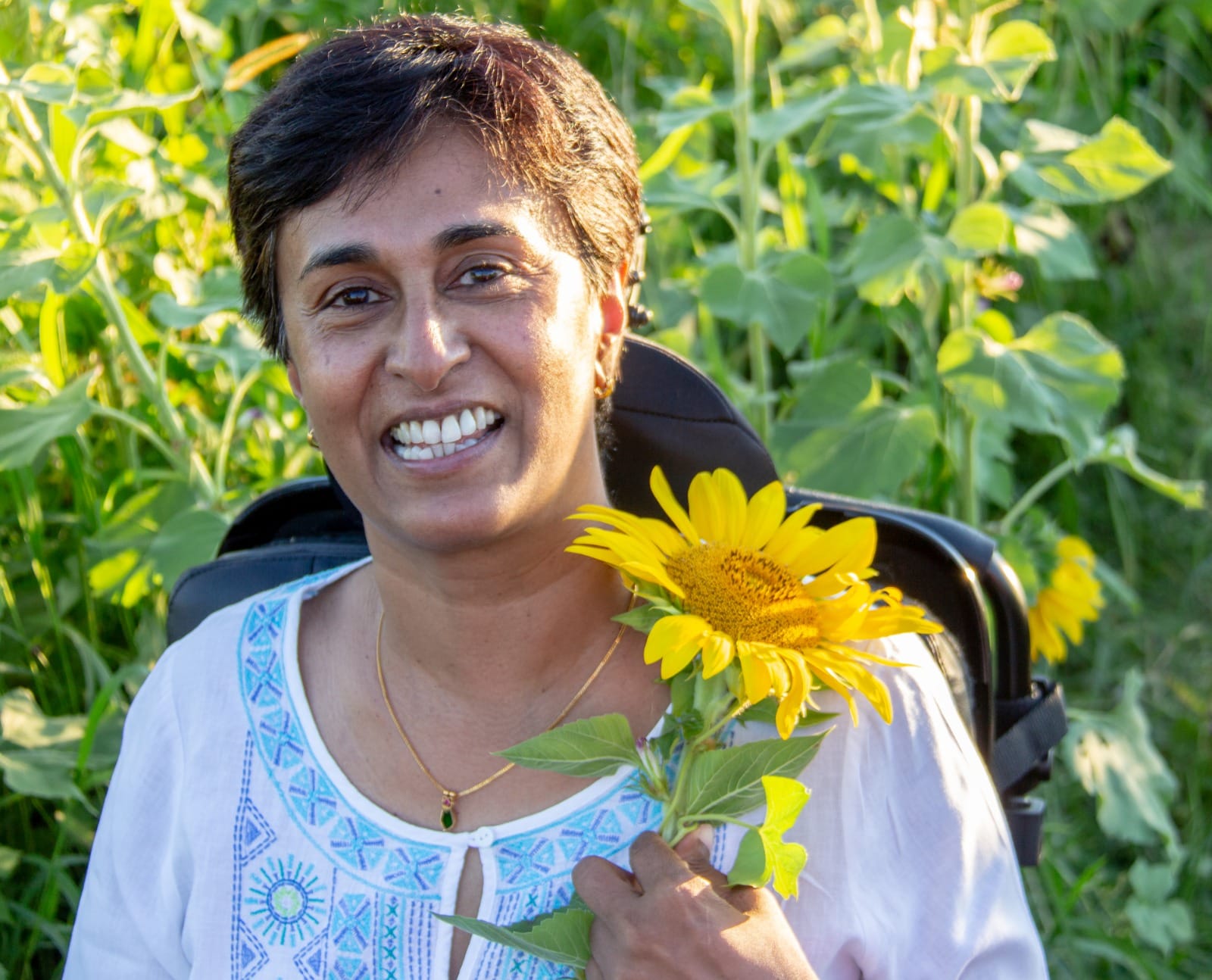
Chachie Joseph's Story
ALS Is Just One Chapter, Not the Title of My Life
Patient story · ALS
I am still the same person I was before ALS. My body has changed, but who I am has not.
Before ALS, I lived a fairly ordinary life. I worked, spent time with friends, travelled, stayed active, enjoyed myself, and helped others when I could. I valued my independence and liked doing things for myself, in my own way.
The first signs that something might be wrong were small. I became clumsy and started tripping. I experienced numbness in my legs and feet that would come and go. At first, it lasted only a short time. Later, it stayed longer.
Then one day, my phone rang while I was sitting on the couch. When I tried to get up, I realized I could not do it without using my arms to push myself up. That was when I knew something was not right.
Getting a diagnosis took time and several doctors. My downstairs landlady had Parkinson’s disease, and she referred me to her neurologist. He performed tests called EMGs and suspected ALS. He sent me to another neurologist, Dr. Pulley, who repeated the tests and also diagnosed ALS.
There were more appointments after that: an ALS clinic in North Carolina, doctors in Philadelphia and Toronto who thought I should be tested for hereditary spastic paraplegia, another visit with Dr. Pulley, and an opinion from the Mayo Clinic in Jacksonville, Florida.
When the diagnosis was first presented to me, it was very matter-of-fact. My mother happened to be visiting from India, so she was in the room. The doctor said that people with ALS often lived only three to five years.
I laughed.
It seemed so unbelievable. I heard what he was saying, but I could not connect it to myself or my life.
I do not remember doing much research or trying to understand everything right away. I think I separated myself from the reality of the diagnosis. That was how I coped, and in some ways, I still do. I was not afraid of dying. Yet for quite a while, I cried whenever I told someone I had ALS. Clearly, I was more affected than I allowed myself to recognize at the time.
At first, not much changed. As the disease progressed, I had to learn to speak up for myself and ask for the access I needed at work. I also had to figure out how to continue travelling for my job.
During that time, I found a community of people affected by ALS. They understood things I was only beginning to experience. They gave me practical advice about what I needed then and what I might need later.
I was often exhausted from working so hard to keep up. Pretending I was fine, and that things were not as difficult as they really were, was exhausting too. In those early years, I became frustrated and annoyed when I could no longer do something for myself, especially when I could not do it exactly the way I wanted.
ALS does not bring just one loss. It brings a series of losses over time.
My mobility, voice, strength, and ability to use my hands have all changed. Singing brought me a great deal of joy, and not being able to sing anymore has been especially sad. Eventually, I had to stop doing the work I once did. I lost both a job I valued and an income.
Becoming more dependent on other people has been difficult. So has learning to ask for help. I sometimes struggle with not being as useful as I would like to be, and it is hard to see the sadness my illness causes my family and friends.
There are practical difficulties, too. Equipment and caregiving cost a great deal. Many places are still inaccessible. Travelling to India has become much more complicated.
And yet, looking back, I can honestly say that I have had, and continue to have, a very good life.
ALS itself is certainly not good. But in living with it, I have experienced so much joy and seen so much goodness in people. Most people want to help. I have had to learn to accept that help graciously, and I have come to understand that accepting help can be good for both the person giving it and the person receiving it.
I am acutely aware of how fortunate I am. I have an accessible home, a twenty-year-old adapted van that I can still drive, a power wheelchair that works, caring friends and family, and volunteer work that gives me purpose. I have the constant support of Sally Ann. These things make a tremendous difference in my life and in my ability to stay positive.
Sally Ann has been there from the first day until now, through every high and low. I am incredibly grateful for her and very lucky to have her in my life.
There are other people whose help has made so much possible. Judie welcomed me to my first ALS support-group meeting. She understood what I was feeling and helped prepare me for each change before it happened, from using a cane to a walker and eventually a wheelchair.
Tim has taken care of my van and helped keep it running. I cannot imagine my life without the freedom those wheels give me. My friend Kamal ensures that my months in India are easy and comfortable and for this I am grateful. And last but not least, my mother, a constant presence.
These are some of the hidden heroes in my story. There have been many others, too, sometimes helping in ways they may not even realize.
My family, friends, caregivers, and medical team have supported me in practical, emotional, and medical ways. They talk through difficult decisions with me and give me room to express sadness, or frustration. They have helped me think ahead and prepare for future needs, rather than waiting for every new problem to become a crisis.
I have always enjoyed people and valued connection. Those moments are even more important to me now. Because of my physical limitations, including me sometimes takes a little more thought or planning. When someone makes that effort, it helps me feel included, loved, and useful.
What I wish people understood is that our bodies do not tell you everything about who we are. Just because someone moves or communicates slowly does not mean the person inside is slow. Speak directly to us. Give us time to respond. Do not talk over us, rush us, or assume we cannot understand.
We still have opinions, responsibilities, dreams, and a sense of humor. I especially want young people to know that they do not need to worry so much about saying the wrong thing. It is okay to ask questions. That is how people learn. Be patient when communication takes longer. Kindness matters, but respect matters just as much, perhaps even more.
Living with ALS has changed how I understand courage. It does not mean being cheerful all the time. Sometimes it means adapting to yet another change, asking for help, accepting a reality you did not choose, and still finding something to laugh about.
It has also taught me that strong relationships are built by people who continue to show up, especially when life becomes difficult. I used to think that a successful life meant being independent and productive. I now understand that a slower life can still be meaningful.
On difficult days, my faith helps me trust that I am seen, cared for, and not alone. Gratitude helps, too. I feel deeply grateful for what I have, both big and small. When I look at my life with some perspective, I can see how much I am still able to do and how much I still have.
My faith, the people around me, and advances in research and technology give me hope. So does the love and purpose in my life. Hope can mean a cure, but it can also mean better treatments, physical comfort, easier communication, useful work, or simply a good conversation with someone I care about.
Of course, I want the medical community to find a cure. I also wish people living with a progressive illness, and their families, did not have to fight separate battles with doctors, insurance companies, equipment providers, and government agencies just to receive the care they need. People need better financial support and faster access to essential equipment. They should not have to wait months for something they need to live safely.
To someone who has just been diagnosed, I would say: give yourself permission to be frightened, angry, or heartbroken.
Find a medical team that specializes in ALS. Begin planning for future communication and mobility needs. Preparing does not mean that you are giving up. It can give you more control over what happens.
And do not spend all your time preparing to die. Keep making plans. Keep doing the things that give your life meaning.
If there is one thing I want people to remember about me, it is this:
ALS is one chapter in my story, but it is not the title of my life.