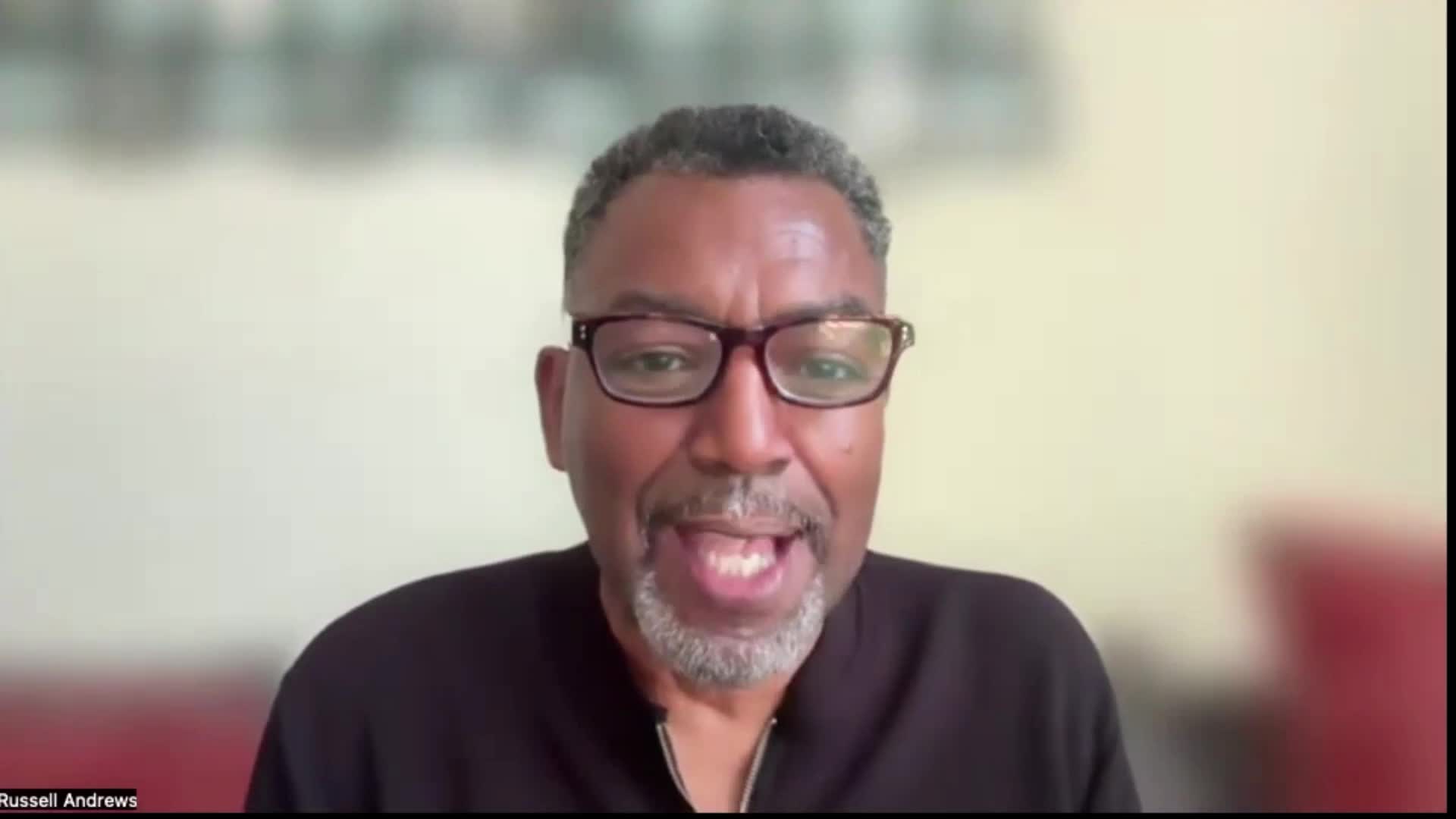
Russell Andrews’ Story
Until I Can’t
Patient story · ALS
I am an actor, a father, a partner, and a storyteller. I am also living with ALS. I have decided to use whatever voice, strength, and visibility I have to help other people on this journey. I will keep doing it until I can’t.
Acting was never my life’s plan. I played football through college, until a severe injury ended that part of my life. I had studied sociology, and when football and my scholarship were gone, I needed a job.
I went to work for the Texas Department of Corrections. I thought I could make an impact. Instead, I discovered a world inside a world inside a world. I stayed for about five years.
Then I took a friend to an audition at the Ensemble Theatre in Houston. It was a way to get away from prison life for a moment. I ended up getting the part he had auditioned for. He got another part, and I found a direction I had never imagined.
I call myself an accidental artist. But once I found acting, I took it seriously. I went back to school to understand the craft. Acting is technical and demanding. I was fortunate to work alongside extraordinary actors, writers, and directors, and I kept learning.
The stage has always been especially meaningful to me. August Wilson was a friend and mentor. I had the opportunity to help bring characters in his work from the table to the stage. My favorite play was Jitney, and my favorite character to play was Levee, the trumpet player whose passion and determination I understood so well.
Over the years, I worked with people who had trained at some of the finest schools in the country. I learned that I could hold my own. My route was unusual, but it showed me what was possible with determination and humility. I fell on my face plenty of times. It was worth it. I would do it again.
When COVID arrived, our industry stopped. Our work depends on people being together. Then came the writers’ and actors’ strikes. After years without steady work, I lost my health insurance. I had not been going to the doctor.
During that time, I began noticing numbness in my hands and fingers, twitching in my neck and shoulders, and difficulty speaking. My fiancée, Erica, and I knew something was happening. At first, I thought I might have had a stroke.
Eventually, a couple of jobs helped me qualify for insurance again. I went to Cedars-Sinai. The doctor I saw recognized that I needed a neurologist and helped arrange an appointment within days. There were tests, blood draws, and evaluations of my swallowing and nerves.
On August 4, 2025, I was told I had ALS.
I was alone. Erica and my daughter were out of the country, and my son was in New York at school. I had to hold that information for a while before sharing it with my family.
Other than knowing about Lou Gehrig, I knew very little about the disease. I asked what I was looking at. Five months? Five years?
The answer was that they did not know. It could be months or years. There was no cure.
The uncertainty was devastating. If someone had given me five weeks, I would have tried to fill those five weeks and go out smiling. But how was I supposed to explain an unknown future to my children? What could I tell my family when I did not know what to expect myself?
Even now, a new twitch or a different sensation can stop me in my tracks. I wonder whether it means something is changing. Living with that uncertainty is part of this experience.
I was angry at first. Eventually, I had to ask myself who I was angry with. Why not me? I had some visibility through my work, and I decided to use it.
That decision did not come without fear. At first, I wondered what I could possibly offer people who had lived with ALS much longer than I had. I was also afraid of what I would see. Wheelchairs, walkers, breathing equipment: I worried I would be looking at my own future.
But the people I met taught me something. Their lives were difficult, and their families were hurting. Yet I encountered warmth, joy, and a spirit I had not expected. My fears did not disappear, but I understood that they were not bigger than my responsibility to help.
Attending an ALS gala in Pasadena with Erica and my daughter helped change things for me. The welcome and connection in that room were real. I knew I wanted to be part of that community.
I wanted to see faces, shake hands, and share tears. I wanted to be where people were. Advocacy also meant accepting the reality of my own diagnosis. Writing about it and speaking publicly helped me understand what was happening to me.
I have learned to be grateful that I can share my experience while I am able. I want what I say and do to mean something to another person or family walking this same road.
ALS affects the simplest things. Buttons. Shoelaces. Holding a spoon. Feeding yourself. These are things most of us do without thinking, until they become difficult.
I believe people care. I believe they want to understand. But unless you are living with this disease, it can be hard to grasp what it takes from a person and what it asks of a family.
I see what it asks of mine. Erica is an artist, too. Preparing for a role takes so much of a person. Moving between that work, caregiving, our relationship, and her own daily life is difficult. I have enormous respect for everything she is navigating.
My children are my best friends. From the time they arrived, my whole world changed. They grew up in theaters, on sets, and in dressing rooms. I have been their coach, the father at the kitchen table talking about life, the person teaching them to cook, shave, and ride a bike.
Now they are being asked to support me in ways none of us planned. I know it is hard for them, even when they do not show me. I do not want them to have to alter their lives around mine. But I see their strength, courage, and determination. They have become advocates from where they stand, too.
When people ask how they can help someone with a serious illness, I tell them that showing up is most of it.
Helping someone get up when they fall matters. Sometimes, though, they need you to sit on the floor with them for a moment. Literally or figuratively. You do not have to have an answer. A long, silent hug can change a moment. Being present is a gift.
As an artist, I have spent my life telling stories and holding a mirror up to society. I hope I can use that experience to help people see the human beings behind ALS. Being known for your work does not protect you from this disease. It can, however, give you an opportunity to bring attention to it.
Access to information matters deeply to me, including in the African American community. I want people to feel able to ask questions, learn more, and reach for support. There is no shame in this diagnosis.
Through the ALS Network, I have seen how practical support can help families: equipment, changes to a home, and help navigating complicated systems. Research and funding matter enormously. So do care and public awareness. Money is needed, but information is also a kind of currency.
That is something I want young people to understand. The tools in your hands can do more than entertain. You can share knowledge, bring attention to a cause, and help people feel less alone. Your voice matters. Find a mission and get involved.
And if you are the person facing an unexpected challenge, do not let fear or anger keep you from accepting help. More people want to help than you may realize. Some simply do not know how. Let them in. Give them a chance to be there.
I hope people remember that I understood this was bigger than me. That I stayed curious, kept learning, and wanted to make a difference. That I believed there were no limits to care and compassion.
Above all, I want my family and friends to know that I love them, and I mean it.
I cannot know exactly what comes next. But I can keep showing up, keep telling my story, and keep walking alongside other people.
Until I can’t.